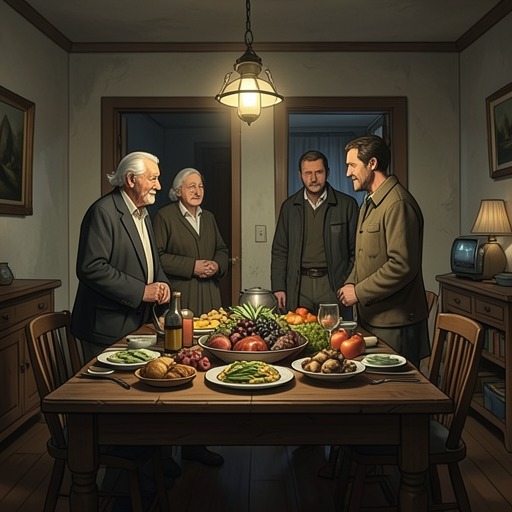
Philemon
Metamorphoses (Ovid Edition)Philemon is the elderly husband of Baucis in the story of Baucis and Philemon, a figure whose significance lies less in individual adventure than in the moral force of a life shared faithfully. He and Baucis possess little, yet their long marriage has made them rich in mutual affection; when divine visitors test their hospitality, Philemon helps transform their poor home into a scene of sacred recognition and receives a reward defined not by wealth but by continued togetherness.
Identity and Domestic Life
Philemon lives with Baucis in a humble shed whose thatched roof is bound from reeds and straw. The couple has been married for many years and remains, in old age, “old in love,” despite having only a small store of worldly goods. His identity is therefore established through two linked conditions: material poverty and emotional abundance. The household is modest, but the marriage within it is stable, affectionate, and sufficient.
The narrative places Philemon within a contrast between mortal simplicity and divine magnificence. The couple’s home is not presented as a diminished version of a palace; its value emerges from the conduct of those who inhabit it. Their poverty does not prevent generosity, and their age does not weaken their attachment. Philemon’s domestic world becomes the setting in which ordinary human loyalty is measured against the failures of a wider community.
The Test of Hospitality
Philemon and Baucis are visited by disguised gods, and their response distinguishes them from the surrounding population. Although their resources are scarce, they offer what they can, treating their guests with the reverence due to strangers in need. The trial exposes a moral hierarchy different from the social one: the poor couple proves worthy while richer households are implicitly judged by their refusal of welcome.
When the visitors reveal their divine status, the humble dwelling is set against a transformed vision of splendor. The gods’ palace-like surroundings include polished marble pavement, sculpted gates, spires, and golden tiles. Philemon is then recognized as the “only just of men,” while Baucis is likewise acknowledged as uniquely worthy. The judgment confirms that his justice is not an abstract reputation but the result of concrete hospitality offered when hospitality seemed costly.
Reward and Shared Wish
The gods invite Philemon to state his desire. The reward scene matters because it refuses the most obvious meaning of divine favor. He is not characterized by a demand for riches, rank, or extended individual power. His deepest good is inseparable from Baucis, and the couple’s fulfillment is framed through their shared life rather than through possession.
That emphasis also gives the episode its emotional precision. The gods can supply grandeur, but Philemon’s value has already been demonstrated in the small acts performed inside the thatched house. Divine recognition enlarges his circumstances without replacing the principle by which he has lived. The reward is meaningful because it preserves the relationship that made the household worthy in the first place.
Transformation and Ending
At the appointed hour, while Philemon and Baucis recount their past adventures at the temple gate, Philemon sees Baucis suddenly sprouting fresh green leaves. The transformation begins before the couple has been separated, turning the threshold of the temple into the threshold between human life and vegetal existence. Baucis, in turn, looks toward Philemon as he undergoes the corresponding change.
Their metamorphosis is therefore reciprocal and simultaneous. Neither spouse is left to witness the other’s disappearance alone, and neither transformation cancels the bond established in marriage. The human couple becomes a paired natural emblem, with the final image preserving their togetherness even as their bodies pass into another form. Philemon’s ending is not an escape from mortality but a conversion of marital fidelity into a lasting visible sign.
Narrative and Thematic Significance
Philemon functions as the hospitable mortal whose apparent insignificance conceals moral distinction. His story belongs to the recurring pattern in which divine or supernatural judgment reveals that outward status cannot guarantee virtue: the humble are elevated, while those who possess more may fail the test of compassion. The episode’s central reversal is consequently ethical before it is magical.
His importance also rests on the way the narrative joins piety to marriage. Philemon is not rewarded as an isolated saint but as one half of a couple whose generosity, age, and mutual love form a single moral unit. The final transformation extends that unity beyond the human sphere. Through him, the tale presents love as something that can survive poverty, divine scrutiny, old age, and bodily change, becoming most durable precisely when ordinary human life has reached its end.